


Our Academics
Embracing Challenge
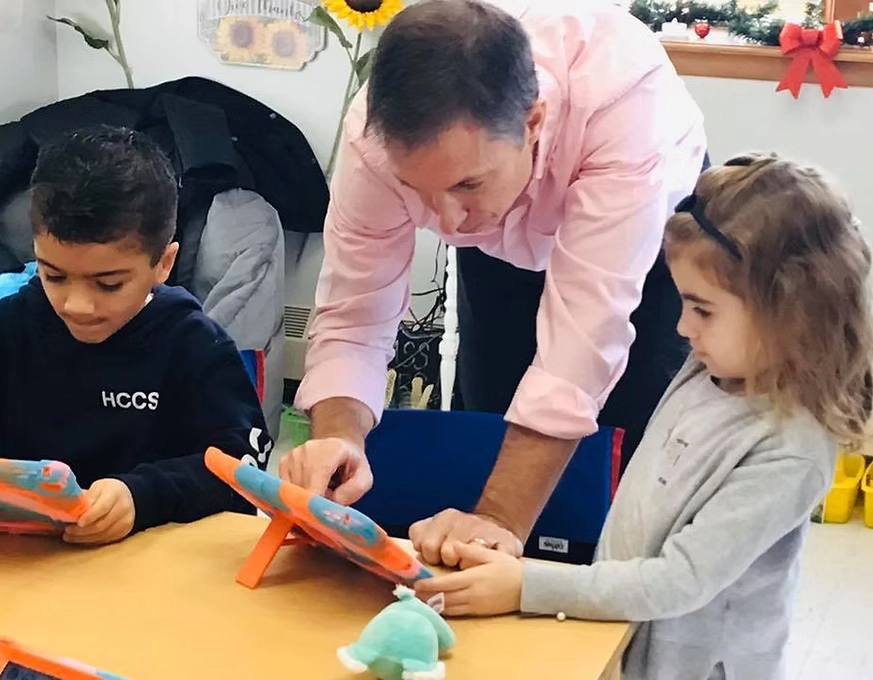
The academic program at Hellenic Classical Charter School places an emphasis on every aspect of student growth and development while meeting state requirements. Suitable class sizes and exceptional, qualified teachers allow us to offer a comfortable and inclusive educational environment while ensuring each student receives the individualized attention and support they need.
Hellenic Classical Charter Schools (HCCS)
Park Slope (PS), est. 2005 ~ Staten Island (SI), est. 2018
Curriculum – Grades K - 8
English Language Arts (Reading, Writing, Speaking, Listening)
- Balanced Literacy Framework, Workshop Model, Paideia (Socratic Seminar)
- Columbia University Reading and Writing Project
Reading Workshop
- Units of Study: Fiction, Nonfiction, Literary Nonfiction, Historical Fiction, Dystopian, Fantasy, Argument
Writing Workshop
- Units of Study: Narrative, Realistic Fiction, Opinion, Argument, Poetry, Informational Writing, Memoir
Phonics/Word Study
- Grades K-1 – Teachers College Phonics Program, Fundations
- Grades 2-3 – Words Their Way
- Grades 4-8 – Wordly Wise
Math
- Workshop Model, Math Talks, Math Centers, Paideia (Socratic Seminar)
- Grades K-5 – GO MATH
- Grades 3-8 Math iXL – This is a digital platform that provides students with a comprehensive learning experience both at school and at home.
- Grades 6-8 – EngageNY, Glencoe, teacher-created resources
- Grade 8 – Common Core Algebra. Students are prepared for the NYS Algebra 1 Regents Exam.
- The curriculum is aligned to the state standards and the standards for mathematical practice. We use EngageNY to complement our Go Math curricular resources.
Science
- Workshop Model, Science Labs
- Paideia (Socratic Seminar)
- Scientific Inquiry/Engineering Process
- Grades K-5 – HMH Science Dimensions
- Grade 6 – Environmental Science
- Grade 7 – Life Science
- Grade 8 – Living Environment topics focusing on cells and heredity, along with Earth Science. Students are prepared for the NYS Earth Science Regents Exam.
Social Studies
NYC DOE program Passport to Social Studies: Students are encouraged to think like historians, to raise questions, think critically, consider many perspectives, and gather evidence in support of their interpretations. The units also align with the New York State K-8 Social Studies Framework and the practices of gathering, interpreting, and using evidence; chronological reasoning and causation; comparison and contextualization; geographic reasoning; economics and economic systems; and Civic Participation.
- Workshop Model
- Paideia (Socratic Seminar)
Technology/STEM
- Grades K-2 – Coding – Scratch Junior
- Grades 3 – 4 – Typing/Keyboard Skills
- Grades 3 – 6 – Microsoft Suite: Word, Excel, PowerPoint
- Grades 7 – 8 – Coding – Scratch
Physical Education
Physical education programming at HCCS is divided into five main activities: health-related fitness, individual athletic activities, team physical activities, dance, and Cooperative Games.
Students must demonstrate competency in a variety of physical activities (games, sports, and exercises) that provide conditioning for each fitness area and proper procedures for safe participation in games, sports, and recreational pursuits.
After-School Programs Are Available
- Greek – Enrichment classes – see Mythology curriculum below
- Grades K – 8 – HCCS students learn to read, write, speak, and understand Greek and are prepared to take the Greek Regents in 8th grade.
Health
Students are exposed to a broad introduction to the different components of the school health program. These components include skills for a healthy life, mental and emotional health, promotion of social skills, conflict resolution, violence prevention, nutrition, alcohol and other drugs, personal care, and communication skills. Students are taught to apply prevention and risk reduction strategies to adolescent health problems. Students learn to recognize potentially dangerous situations and how to avoid or reduce their risk.
Teen Health – by M.H. Bronson, M. J. Cleary, and B.M. Hubbard is the primary resource for the course.
Latin
- Students in grades 6-7 begin to learn Latin.
Music
Students learn how to read music, identify types of music (classical, jazz, rhythm and blues, spiritual, gospel, rock and roll), and play musical instruments like the recorder, xylophone, guitar, and more!
Art
Students study a broad variety of art periods, types, and forms throughout history; complete works of art themselves that are representative of some of these periods and types; and are able to understand the major artistic contributions of diverse cultures, including Greece. They also learn how art intersects with history, economics, religion, philosophy, and culture.
Social Emotional Learning – Grades K-5 – Competent Kids, Caring Classrooms Program
Chess – Grades K-5
The Paideia Seminar at HCCS
- Students at HCCS have been participating in seminars since the school’s inception (2005 for our Park Slope campus and 2018 for our Staten Island campus.)
- Students in grades K–8 participate in seminars, usually as a culminating activity after a unit of study, approximately once a month. As part of our efforts to increase rigor in our classrooms, seminars will be conducted twice a month.
- Students at HCCS learn how to set individual goals for themselves as seminar participants. Students are also asked to reflect on their seminar performance, giving them the opportunity to improve themselves in upcoming seminars.
- The Paideia Seminar and its intellectual rigor pave the road for college and career readiness.
- For more information: Paideia Seminar
Hellenic Classical Charter Schools (HCCS)
Greek Mythology Curriculum—Grades K - 8
Kindergarten
Through the study of Aesop’s fables, folk tales, and fairy tales, the students will understand that the ancient Greeks created a wealth of compelling stories to explain the mysteries and complexities of the world and also relate these myths to our lives today. To have students familiarize themselves with and appreciate Greek music and Greek dance.
First Grade
Through the study of Mythology, the students will understand that the ancient Greeks created a wealth of compelling stories to explain the mysteries and complexities of the world and also relate these myths to our lives today.
Second Grade
Through the study of mythology, the students will understand that the ancient Greeks created a wealth of compelling stories to explain the mysteries and complexities of the world and also relate these myths to our lives today.
Third Grade
Through the study of mythology, the students will understand that the ancient Greeks created a wealth of compelling stories to explain the mysteries and complexities of the world and also relate these myths to our lives today.
Fourth Grade
The purpose of the Greek Culture lesson is to enable the students to understand the historical and cultural life of the Greek nation through the ages, to develop and cultivate the historical thoughts, connections, historical events, and historical evolution, and to give the students the motivation to become involved in historical subjects/topics and to develop the interest and ability for research.
Fifth Grade - Greek History
The purpose of the Greek Culture lesson is to study the first Greeks, 3000 BC to c. 1940 BC
Sixth Grade - Greek History
The purpose of the Greek Culture lesson is to study Greece and the birth and rise of the city-state of Sparta, as well as the Greek family and household, the first Greek government, and the first Congress.
Seventh Grade – Greek History
The purpose of the Greek Culture lesson is to study the famous Greek battles, the birth and rise of the city-states of Athens and Thessaloniki, famous Greek architecture, and the architects and sculptors who created the pieces.
Eighth Grade – Greek History
The purpose of the Greek culture lesson is to study the ancient and modern Greek Olympics, the Golden Age of Greece, the Oracle of Delphi, and the Hellenistic world.
 English
 Chinese (Traditional)
 Greek
Greek Russian
 Spanish